





























No products in the cart.


In the constant buzz about cryptocurrencies, it’s often difficult to decide what really matters. But if all goes according to plan this month, the energy-hungry digital sector will undergo the biggest change in years.
World’s Second Largest Cryptocurrency Ethereum Launches Tomorrow Be expected Start the technology transformation, and when it’s done, its carbon footprint will be 99% plunge.
The rapid growth of cryptocurrencies in recent years is staggering.
Unfortunately, so are their contributions climate changedue to the enormous amount of power used by the computers that manage the buying and selling of crypto coins.
For example, Bitcoin, the world’s largest virtual currency. At a time when the world is desperately trying to reduce energy consumption, Bitcoin uses more energy than a medium-sized country each year. Argentina.
If the Ethereum switch is successful, Bitcoin and other cryptocurrencies will be under a lot of pressure to deal with the problem.
Cryptocurrency is a digital currency system where people pay each other directly online.
Unlike traditional currencies, cryptocurrencies are not controlled from a single location such as a central bank.instead they are managed by ‘ blockchain‘: A distributed global network of powerful computers. These computers are known as “miners”.
Reserve Bank of Australia Offers This short explanation of how it all works (edited for brevity):
Suppose Alice wants to send 1 unit of cryptocurrency to Bob. Alice initiates a transaction by sending an electronic message containing her instructions to the network where all users can see the message.
A transaction sits with a group of other recent transactions waiting to be compiled into a block (or group) of recent transactions.
Information from blocks is converted into cryptographic code, and miners race to solve the code and add new transaction blocks to the blockchain.
When a miner successfully solves a code, other users of the network check the solution and reach consensus that the solution is valid. A new block of transactions is added to the end of the blockchain, confirming Alice’s transaction.
This process used by most cryptocurrencies is called proof of work mining. A core design feature is the use of computations that require a lot of computer time and a lot of power to perform.
Consume approx in bitcoin alone 150 terawatt hours annual power consumption. Producing that energy releases about 65 million tons of carbon dioxide into the atmosphere each year. This is about the same emissions as Greece.
research It suggests that Bitcoin generated emissions responsible for about 19,000 future deaths last year.
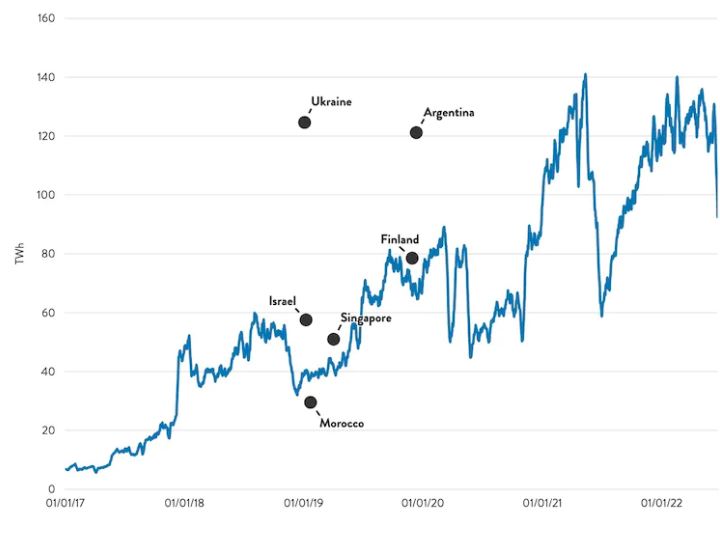
The Proof of Work approach intentionally wastes energy. Data in a blockchain has no inherent meaning. Its sole purpose is to record difficult but meaningless calculations that provide the basis for allocating new cryptocoins.
Cryptocurrency proponents make a variety of excuses for their enormous energy consumption, but none stand up to scrutiny.
For example, some try to justify the carbon footprint of cryptocurrencies by saying that some miners use renewable energy.That may be true, but they can Shift Other Potential Energy Users – Some have to use coal-fired or gas-fired power.
But now Bitcoin’s most successful rival, Ethereum, is changing course. It promises to switch computing technology to something far less polluting this month.
What is a switch
Ethereum projects include ditching the Proof of Work model for a new model called Proof of Stake.
In this model, crypto transactions are verified by users, who hold large amounts of blockchain tokens (in this case, Ethereum coins) as collateral. If the user cheats, they lose their wager.
Importantly, it eliminates the vast network of supercomputers currently used to check transactions. This is because it is a relatively easy task for you to check yourself. Eliminating computer miners reduces Ethereums power usage by an estimated 99%.
Some smaller cryptocurrencies, such as the Ada coin traded on the Cardano platform, use proof of stake but so far have been limited to margins.
Over the past year, Ethereum has running A new model of experimental blockchain. But this month, the model will be integrated into the main platform.
Nowhere to hide your cryptocurrencies
So what does this mean?
Ethereum experiments can fail. For example, if some stakeholder finds a way to manipulate the system.
But if the switch is successful, Bitcoin and other cryptocurrencies will be under pressure to abandon or shut down their proof-of-work model.
This pressure has already started.founder of tesla Elon Musk last year announced His company no longer accepts Bitcoin payments for electric vehicles due to the currency’s carbon footprint.
New York State Senate in June passed the bill Prohibit some Bitcoin operations that use carbon-based power. (However, this decision requires the approval of the Governor of New York and may be rejected.)
And in March of this year, the European Parliament voted on a proposal to ban the proof of work model.the proposal is defeated.
But as Europe heads into cooler months and deals with the energy crisis caused by sanctions on Russian gas supplies, energy-hungry cryptocurrencies will continue to take the lead.
One thing is clear: as the need to reduce global emissions becomes more pressing than ever, cryptocurrencies will run out of excuses for their terrible energy use.
John QuiginProfessor, Faculty of Economics, University of Queensland
The original publisher of this article was conversation. read Original work.